LLM Ops
Published on:
Khursheed Hassan

Every enterprise moving AI into production eventually hits the same set of challenges. The security team wants to know where the data lands. The legal team wants to know who can see or intercept the prompts. The compliance team wants an audit trail. And the CFO wants to know why the LLM bill doubled last quarter with no visibility into what caused it. Most AI gateway vendors answer the first three questions with a policy document and a shared responsibility matrix. Cloudidr answers them with an elegant architecture -easy to deploy, monitor and manage.
The CIO Challenge
When eams start building with LLMs, the default path is to call a provider API directly. OpenAI, Anthropic, Google, AWS Bedrock — the SDKs are simple, the results are impressive, and the initial costs seem manageable.
Then in production prompts containing customer data, internal documents, proprietary designs, and sensitive business logic start flowing through third-party endpoints. Finance discovers the API bill at month end with no breakdown of which team, project, or workflow caused it. A runaway agent loop generates thousands of calls overnight. And it compounds as AI adoption grows.
What Enterprises Actually Need
A Chief AI Officer or CIO evaluating LLM infrastructure needs four things — and needs them answered architecturally, not contractually:
1. Data sovereignty — Prompts, responses, and usage logs must stay within the enterprise's own cloud perimeter.
2. Financial governance — Real-time visibility into every dollar of LLM spend, attributed by team, project, agent, and model. Hard budget controls that block overspend before it happens.
3. Complete auditability — Every action the vendor takes in your environment must be logged, time-bounded, and independently verifiable. Vendor access must be revocable in seconds.
4. Cost optimization — Intelligent routing that selects the cheapest model capable of handling each request — automatically, without any code changes — so AI adoption scales without budget shock.
Cloudidr's enterprise deployment delivers all four.
The Architecture: Fully Inside Your AWS Account
Cloudidr deploys as a full-stack AI Gateway inside your AWS VPC. Every component — the gateway, the database, the cache, the dashboard, the budget enforcement engine — runs in your account, under your control, on your infrastructure.
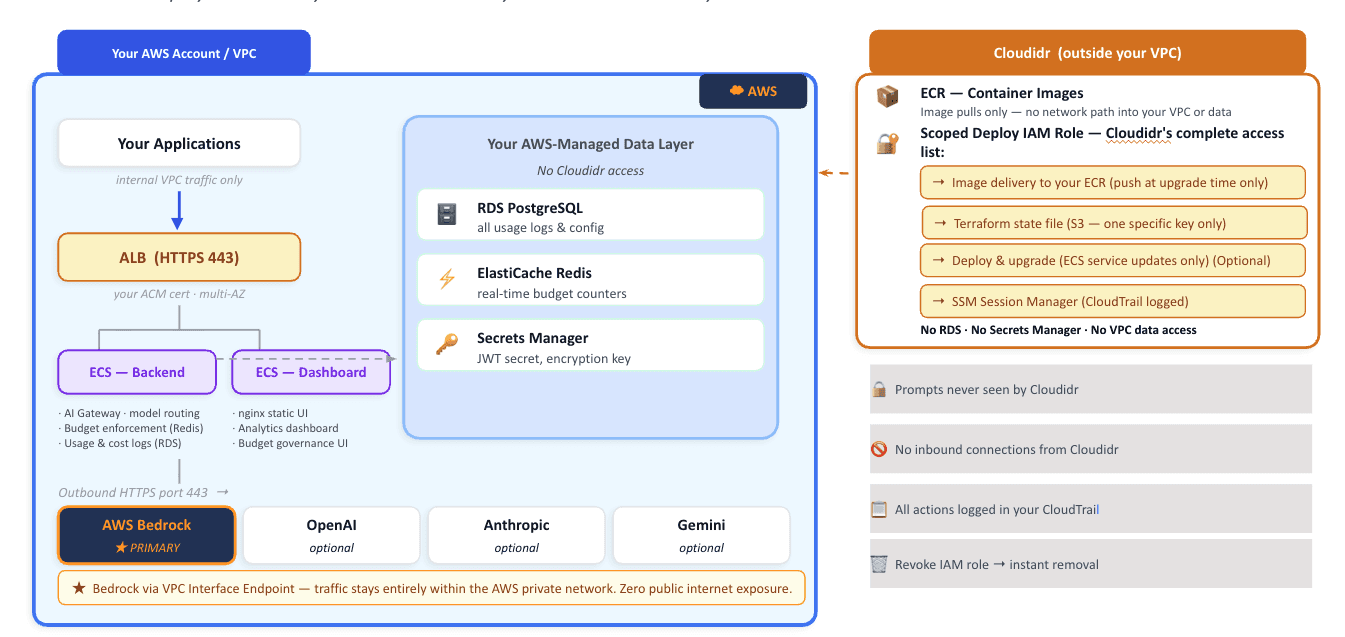
This is not a hybrid model. Cloudidr's infrastructure does not sit in the request path at runtime. There is no control plane phoning home. Your prompts flow from your application to your gateway to your LLM provider — and back. The vendor never sees them.
Data Sovereignty: What "Never Leaves" Actually Means
Most vendors offer data residency as a contractual commitment. Cloudidr makes it part of our architecture. At runtime, Cloudidr has no network path into your VPC. Prompt content, response content, and usage metadata are written to your RDS database inside your VPC. Your analytics dashboard runs on your ECS cluster and reads from your database. The weekly CFO spend report is generated from your data, in your infrastructure, and delivered to your inbox.
For AWS Bedrock workloads, the LLM request path never touches the public internet. Bedrock traffic flows through a VPC Interface Endpoint on the AWS private backbone — from your ECS container to the Bedrock model endpoint and back, entirely within AWS's private network.
For organizations that require complete network isolation — no NAT Gateway, no outbound internet at all — Cloudidr can operates in Bedrock-only mode. The entire AI stack runs air-gapped within your VPC. (Note: you still have an option to directly call LLM providers bypassing Bedrock if you choose to.)
Financial Governance is Critical
The second failure mode of enterprise AI adoption is financial. Teams discover LLM costs at month end in a consolidated invoice with no breakdown. There is nothing in place to stop a runaway agent loop before it generates thousands of dollars in API calls.
Cloudidr's AI Gateway sits between every application and every LLM provider, capturing cost attribution at the request level — tagged by team, department, project, and agent. Budget limits are enforced in real time. When a budget threshold is reached, requests are blocked automatically. Finance teams see live spend, not end-of-month surprises.
Every dollar of LLM spend is visible, attributed, and governed before it leaves your account.
Intelligent Routing: Cutting LLM Costs by 75–90%
Developers default to premium models because they are reliable. The result is that simple summarization, classification, and formatting tasks — which represent the majority of enterprise LLM volume — are processed by the most expensive models available.
Cloudidr's intelligent routing engine evaluates every prompt in real time and routes it to the cheapest model capable of meeting the quality threshold for that specific request. No application code changes. No developer intervention. The routing decision happens invisibly inside the gateway.
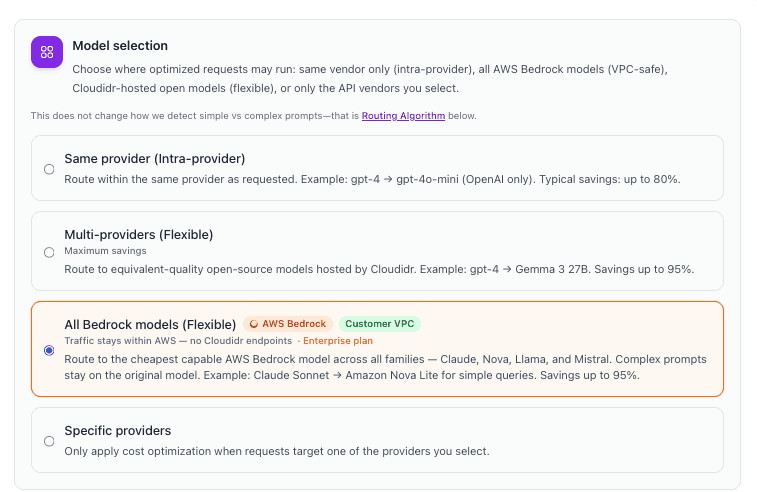
Three routing modes are available:
Same-provider routing routes within the same provider. A request targeting Claude Sonnet that is classified as simple is routed to Claude Haiku — same provider, same network path, dramatically lower cost. Typical savings: up to 80%.
Multi-provider routing routes across providers to the globally cheapest capable model — Gemini Flash Lite, Qwen, or Cloudidr-hosted open source models — while maintaining output quality. Typical savings: up to 95%.
All Bedrock models - routes to the cheapest capable model across the full AWS Bedrock catalogue — frontier models (Claude, Llama) and open source models (GLM, Minimax, and others) — keeping every token on the AWS private backbone. Ideal for enterprises fully committed to AWS or operating in regulated environments where traffic must stay within the AWS network.
Organizations consistently see 75–90% reduction in LLM spend compared to a static always-premium baseline. That saving compounds as AI adoption grows.
Audit Trail: Provable, Bounded, Revocable Vendor Access
Regulated environments — and increasingly, every enterprise security team — require that vendor access is not just limited but independently verifiable. Cloudidr's deployment access operates through a scoped IAM role that the customer controls entirely. The role carries the minimum permissions required to deliver container images and perform upgrades — nothing more. Every action Cloudidr takes in your account is logged in your CloudTrail under that role ARN. You can query the complete history of every image push, every service update, and every session at any time.
When you want to end the relationship, delete the IAM role. Cloudidr's access to your account is gone instantly. Your VPC, your RDS database, your Redis cache, and your Terraform state remain running and under your control. There is no data to migrate, no vendor to negotiate with, and no off-boarding process.
Competitive Comparison
Cloudidr | Portkey | LiteLLM (AWS Ref Arch) | |
|---|---|---|---|
Data stays in customer VPC | ✅ Fully dark | ⚠️ Control plane phones home | ✅ When self-hosted correctly |
Air-gapped / Bedrock-only mode | ✅ Yes | ❌ Not supported | ⚠️ Requires hardened build |
Customer-managed KMS (BYOK) | ✅ Yes | ❌ No | ❌ No |
VPC Interface Endpoints | ✅ Provisioned automatically | ❌ Not included | ❌ Not in AWS ref arch |
Intelligent cost routing | ✅ 30–90% savings | ❌ No | ❌ No |
Real-time budget enforcement | ✅ Yes | ❌ No | ❌ No |
Finance reporting | ✅ From your RDS | ❌ No | ❌ No |
Agent traces | ✅ From your RDS | ⚠️ Partial | ❌ No |
Managed deployment | ✅ Under your change control | ⚠️ Partial | ❌ Customer-operated |
Vendor access revocation | ✅ Delete IAM role — instant | ⚠️ Complex | ✅ N/A — no vendor access |
Suitable for HIPAA / SOX / ITAR / CMMC | ✅ Yes | ❌ Split-plane disqualifier | ⚠️ Possible with hardening |
The Question Every CIO Should Ask
Before deploying any AI gateway, ask the vendor one question: "If I delete your IAM role right now, what happens to my data, my logs, and my analytics?" If the answer involves migrating data off their platform, negotiating an export, or losing historical analytics — their control plane has your data.
With Cloudidr, the answer is simple. Your VPC keeps running. Your RDS keeps your logs. Your dashboard keeps working. Cloudidr loses access to your account immediately and permanently.
That is what data sovereignty means in practice.
Getting Started
Enterprise VPC deployment is available for organizations requiring full data sovereignty, regulated workload support, or strict security perimeter requirements. Available on AWS Marketplace.
Contact us at hello@cloudidr.com or visit cloudidr.com to discuss your deployment requirements.
Cloudidr LLM Ops — AI FinOps Gateway · cloudidr.com