LLM Ops
Complete LLM Pricing Comparison 2026: We Analyzed 105 Models So You Don't Have To
Complete LLM Pricing Comparison 2026: We Analyzed 105 Models So You Don't Have To
Complete LLM Pricing Comparison 2026: We Analyzed 105 Models So You Don't Have To
Complete LLM Pricing Comparison 2026: We Analyzed 105 Models So You Don't Have To
Published on:
Khursheed Hassan
[Updated LLM model pricing can be found in our regularly updated page here]
Recently, a startup founder complained: "Spent has climbed up to $3,000/month on GPT-4 for our chatbot. Is that normal?"
I analyzed their usage pattern:
90% were simple chatbot responses
Average 50 input tokens, 150 output tokens per request
Processing about 20 million tokens per month
The shocking discovery: They could run the same workload on GPT-4o Mini with identical quality for just $150/month.
Readers can get a high level estimate of their LLM savings using this free LLM API Savings Calculator cloudidr.com/savings-calculator
That's a 95% cost reduction — or $34,200 saved annually. You can save autonomously by Trying out Cloudidr LLM Ops for free → — it saves you by routing your requests intelligently across all 105 models automatically.
This isn't an isolated case. After analyzing pricing across 105 LLM models from Anthropic, OpenAI, and Google, I've found that most companies are dramatically overpaying because they don't understand a critical pricing detail:
Output tokens cost 3-10x more than input tokens.
The Pricing Trick Every Provider Uses
When you visit OpenAI's pricing page, you'll see something like this:
GPT-4o Mini: $0.15 per 1 million tokens
Sounds cheap, right? But here's what they don't emphasize: that's only the input price.
The complete pricing is:
Input: $0.15 per 1M tokens
Output: $0.60 per 1M tokens
For a typical chatbot that generates 2x more output than input (which is common), your actual cost is:
Real cost: (1M × $0.15) + (2M × $0.60) = $1.35 per million total
That's 9x higher than the advertised "$0.15" price.
Our Comprehensive Analysis: 105 Models Compared
To help companies make informed decisions, we analyzed every major LLM API across three providers. You can explore the full interactive breakdown on our LLM API Pricing Comparison page:
Anthropic Claude: 12 models
OpenAI GPT: 61 models (including GPT-5.4, reasoning, audio, image, and code models)
Google Gemini: 32 models (including Gemini 3.1, video, music, and embedding models)
For each model, we calculated:
Real total cost (input + output combined)
Context window limits
Best use cases
Quality-to-price ratio
Here's what we found.
The Winners: Three Models You Should Know
After comparing 60+ models, three clear winners emerged for different use cases:
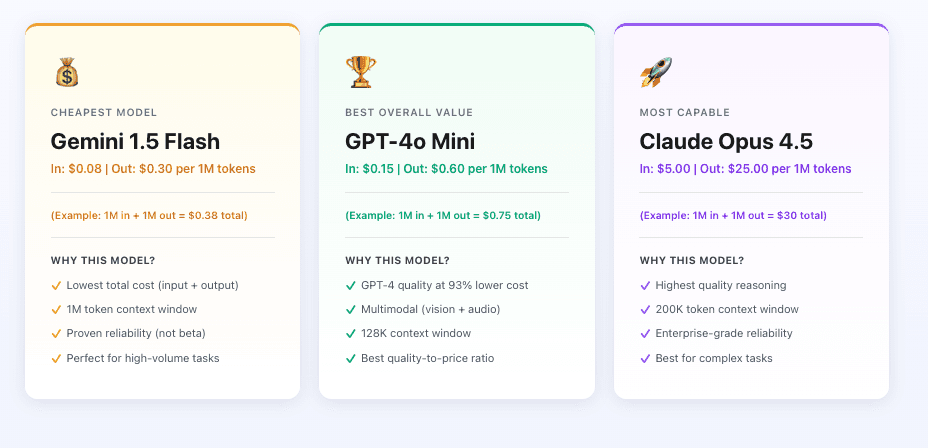
🏆 Best Overall Value: GPT-4o Mini
Price: $0.75 per 1M tokens total (input + output at 1:1 ratio)
Why it wins:
GPT-4 level quality at 93% lower cost
Multimodal (vision + audio support)
128K token context window
Perfect for chatbots, content generation, and most production use cases
Best for: Most companies should start here
Runner-up: Gemini 2.5 Flash ($0.30/$2.50) — best if you need 1M token context + hybrid reasoning
💰 Cheapest Option: Gemini 2.5 Flash-Lite
Price: $0.50 per 1M tokens total (1:1 input/output ratio)
Why it wins:
Lowest cost on any actively supported model
1M token context window
Includes thinking tokens in output
Built for at-scale, high-volume workloads
Best for: High-volume tasks, cost-sensitive applications, document processing
Note: Gemini 2.0 Flash-Lite was cheaper at $0.375 total but is deprecated and shutting down June 1, 2026. Gemini 2.5 Flash-Lite is the recommended replacement..
🚀 Most Capable: Claude Opus 4.6
Price: $30 per 1M tokens total
Why it wins:
Anthropic's latest and most powerful model
1M token context window at standard pricing (no surcharge)
Best-in-class for complex reasoning, agentic tasks, and long document analysis
128K max output tokens — double the previous limit
State-of-the-art on coding, legal reasoning, and multi-needle retrieval benchmarks
Best for: Complex analysis, long documents, mission-critical agentic applications where quality matters more than cost
Runner-up: Gemini 3.1 Pro Preview ($2.00/$12.00) — strong multimodal alternative at a significantly lower price
The Complete Pricing Breakdown
Here's how the major models compare (prices per 1M tokens, assuming 1:1 input/output ratio):
Anthropic Claude Models
Model | Input | Output | Total (1:1) | Context | Best For |
|---|---|---|---|---|---|
Claude Opus 4.6 | $5.00 | $25.00 | $30.00 | 1M tokens | Complex reasoning, agentic tasks |
Claude Opus 4.5 | $5.00 | $25.00 | $30.00 | 200K tokens | Enterprise workloads |
Claude Opus 4.1 | $15.00 | $75.00 | $90.00 | 200K tokens | Legacy enterprise |
Claude Sonnet 4.6 | $3.00 | $15.00 | $18.00 | 1M tokens | Latest balanced model |
Claude Sonnet 4.5 | $3.00 | $15.00 | $18.00 | 200K / 1M* | Balanced quality/cost |
Claude Sonnet 4 | $3.00 | $15.00 | $18.00 | 200K / 1M* | Production applications |
Claude Haiku 4.5 | $1.00 | $5.00 | $6.00 | 200K tokens | Fast, affordable tasks |
Claude Haiku 3.5 | $0.80 | $4.00 | $4.80 | 200K tokens | High-volume simple tasks |
Claude Haiku 3 | $0.25 | $1.25 | $1.50 | 200K tokens | Ultra-budget tasks |
*Sonnet 4.5 and Sonnet 4: 1M context available in beta for usage tier 4+ organizations.
Context window update: Claude Opus 4.6 and Sonnet 4.6 now include the full 1M token context window at standard pricing — no long-context surcharge. See all Claude models and pricing →
OpenAI GPT Models (Top Picks)
Model | Input | Output | Total (1:1) | Best For |
|---|---|---|---|---|
GPT-5.4 | $2.50 | $15.00 | $17.50 | Latest flagship |
GPT-5.4-Pro | $30.00 | $180.00 | $210.00 | Enterprise maximum capability |
GPT-5.4-Mini | $0.75 | $4.50 | $5.25 | Fast, affordable GPT-5.4 |
GPT-5.4-Nano | $0.20 | $1.25 | $1.45 | Ultra-low cost |
GPT-5.2 | $1.75 | $14.00 | $15.75 | General purpose |
GPT-5 | $1.25 | $10.00 | $11.25 | Standard GPT-5 |
GPT-4.1 | $2.00 | $8.00 | $10.00 | Latest GPT-4, balanced cost |
GPT-4o | $2.50 | $10.00 | $12.50 | Multimodal flagship |
GPT-4o Mini | $0.15 | $0.60 | $0.75 | Best value overall |
GPT-4.1-Mini | $0.40 | $1.60 | $2.00 | Fast GPT-4.1 |
GPT-4.1-Nano | $0.10 | $0.40 | $0.50 | Ultra-affordable |
o4-Mini | $1.10 | $4.40 | $5.50 | Latest mini reasoning |
o3 | $2.00 | $8.00 | $10.00 | Latest reasoning model |
o3-Pro | $20.00 | $80.00 | $100.00 | Enterprise reasoning |
o1 | $15.00 | $60.00 | $75.00 | Advanced reasoning |
o3-Deep-Research | $10.00 | $40.00 | $50.00 | Deep analysis & research |
Note: o-series models include "thinking tokens" in output pricing, which can significantly increase costs for complex reasoning tasks. See all 61 OpenAI models →
Google Gemini Models
Model | Input | Output | Total (1:1) | Context | Best For |
|---|---|---|---|---|---|
Gemini 3.1 Pro Preview | $2.00 | $12.00 | $14.00 | 2M tokens | Most capable, multimodal |
Gemini 3.1 Flash-Lite Preview | $0.25 | $1.50 | $1.75 | 1M tokens | Agentic tasks, translation |
Gemini 3 Flash Preview | $0.50 | $3.00 | $3.50 | 1M tokens | Frontier intelligence + search |
Gemini 2.5 Pro | $1.25 | $10.00 | $11.25 | 1M tokens | Coding, complex reasoning |
Gemini 2.5 Flash | $0.30 | $2.50 | $2.80 | 1M tokens | Hybrid reasoning, thinking budgets |
Gemini 2.5 Flash-Lite | $0.10 | $0.40 | $0.50 | 1M tokens | Cheapest active model |
Gemini 2.5 Computer Use | $1.25 | $10.00 | $11.25 | 200K tokens | Browser control agents |
Gemini 1.5 Pro | $1.25 | $5.00 | $6.25 | 1M tokens | Stable previous-gen pro |
Gemini 1.5 Flash | $0.08 | $0.30 | $0.38 | 1M tokens | Stable, affordable (legacy) |
Deprecation alert: Gemini 2.0 Flash and Gemini 2.0 Flash-Lite are deprecated and shutting down June 1, 2026. Migrate to Gemini 2.5 Flash or Flash-Lite respectively. See all 32 Google Gemini models →
Google offers a free tier: up to 1,500 RPD on most 2.5 models — great for prototyping.
Five Critical Pricing Mistakes Companies Make
1. Ignoring Output Token Costs
Mistake: Only looking at input pricing
Example: A company assumes GPT-4 Turbo costs $1/million based on input pricing, but with a 1:3 input/output ratio, they're actually paying $4/million.
Fix: Always calculate total cost based on your expected input/output ratio.
2. Using Premium Models for Simple Tasks
Mistake: Using GPT-5.4-Pro or Claude Opus for basic chatbot responses
Example: A customer support chatbot using GPT-5.4-Pro ($210/million total) when GPT-4o Mini ($0.75/million) provides identical quality.
Savings: 99%+ cost reduction
Fix: Match model capability to task complexity.
3. Not Considering Context Window
Mistake: Chunking long documents because you didn't check context limits
Example: Using a 32K context model and chunking a 500K document into pieces, paying for redundant processing.
Fix: Use Claude Opus 4.6 or Sonnet 4.6 (1M tokens), or Gemini 2.5 Pro/Flash (1M tokens) for long documents. Gemini 3.1 Pro Preview now supports 2M tokens.
4. Ignoring Batch API Discounts
Mistake: Using real-time API when batch processing would work
Example: OpenAI offers 50% discount for batch API with 24-hour turnaround.
Savings: 50% for non-time-sensitive workloads
Fix: Use batch processing for analytics, content generation, and data processing.
5. Not Testing Cheaper Alternatives
Mistake: Assuming expensive = better
Example: Many companies never test if GPT-4o Mini or Gemini 2.5 Flash-Lite can handle their use case.
Reality: For 70–80% of production workloads, mid-tier models perform identically to premium models.
Fix: A/B test cheaper models before committing to expensive ones.
How to Choose the Right Model: Decision Framework
Step 1: Define Your Use Case
Simple tasks (FAQ, basic chatbot, simple content): → Gemini 2.5 Flash-Lite ($0.50) or GPT-4o Mini ($0.75)
Balanced workloads (most production apps): → GPT-4.1 ($10) or Claude Sonnet 4.6 ($18)
Complex reasoning (analysis, research, strategy): → Claude Opus 4.6 ($30) or Gemini 3.1 Pro Preview ($14)
Long documents (200K+ tokens): → Claude Opus 4.6 (1M), Sonnet 4.6 (1M), or Gemini 2.5 Pro (1M)
Ultra-long context (1M+ tokens): → Gemini 3.1 Pro Preview (2M context)
Step 2: Estimate Your Volume
Low volume (<10M tokens/month): Cost is minimal — choose best quality
Medium volume (10–100M tokens/month): Cost starts mattering — test cheaper alternatives
High volume (>100M tokens/month): Cost is critical — optimize aggressively with model routing
Step 3: Calculate Your Input/Output Ratio
Use Case | Typical Ratio |
|---|---|
Chatbot | 1:1.5 (input:output) |
Summarization | 10:1 (more input than output) |
Content generation | 1:10 (more output than input) |
Code completion | 1:2 |
Use our interactive comparison page to calculate real costs based on your ratio: LLM API Pricing Comparison 2026 → cloudidr.com/llm-pricing
Step 4: Run A/B Tests
Don't assume the most expensive model is best. Test:
Baseline: Your current model
Budget option: Gemini 2.5 Flash-Lite or GPT-4o Mini
Mid-tier option: Claude Sonnet 4.6 or GPT-4.1
Measure quality (blind human evaluation), latency, cost, and error rates.
Real-World Cost Comparison Examples
Example 1: Customer Support Chatbot
Usage: 1 million conversations/month, avg 50 input + 150 output tokens = 200M tokens total
Option | Cost/Month | Annual Cost |
|---|---|---|
GPT-4 Turbo | $5,000 | $60,000 |
GPT-4o | $2,750 | $33,000 |
GPT-4o Mini | $97.50 | $1,170 |
Savings vs GPT-4 Turbo: $4,902/month ($58,830/year) with identical quality
💡 Don't want to manually manage model selection? Cloudidr's LLM Ops routes each request to the right model automatically — so you get GPT-4o Mini pricing for simple queries without changing a line of application code.
Example 2: Document Summarization
Usage: 100 docs/day × 50K tokens each, 500 token summaries = 150M input + 1.5M output/month
Option | Cost/Month |
|---|---|
Claude Opus 4.6 | $787.50 |
Claude Sonnet 4.6 | $472.50 |
Gemini 2.5 Flash | $48.75 |
Gemini 2.5 Flash-Lite | $15.60 |
Savings: Up to 98% — but test quality before switching to the cheapest option.
💡 LLM Ops can A/B test models for you in production and automatically shift traffic to the best-performing cheapest option. Start free →
Example 3: AI Code Assistant
Usage: 50K completions/day, avg 100 input + 200 output tokens = 150M input + 300M output/month
Option | Cost/Month |
|---|---|
GPT-4o | $3,375 |
GPT-4o Mini | $202.50 |
GPT-4.1-Mini | $570 |
Savings: $3,172/month switching from GPT-4o to GPT-4o Mini with nearly identical code quality.
💡 Not sure which model is right for your workload? Cloudidr's LLM Ops analyzes your prompt complexity in real time and routes to the optimal model — across Claude Opus 4.6, GPT-5.4, Gemini 3.1 Pro, and 102 more.
Special Considerations for Different Providers
Anthropic Claude: Best for Safety & Long Context
Pros:
Industry-leading safety features and lowest over-refusal rate
Opus 4.6 and Sonnet 4.6: 1M context at standard pricing
Excellent for sensitive and regulated industries
Best-in-class on coding benchmarks (Terminal-Bench 2.0, BigLaw Bench)
Context compaction: automatically summarizes context for effectively infinite conversations
Cons:
More expensive than competitors at premium tiers
No free tier
1M context for older models requires usage tier 4+
Best for: Healthcare, finance, legal, enterprise compliance, agentic workloads
OpenAI GPT: Most Features & Options
Pros:
Widest model selection (61 models including GPT-5.4 family)
Multimodal: vision, audio, realtime, transcription, image generation
Batch API with 50% discount
New transcription models with speaker diarization
Computer use and deep research models
Cons:
Complex and rapidly changing pricing structure
Frequent model updates can break integrations
Pro/enterprise models are very expensive (GPT-5.4-Pro at $210/M total)
Best for: Startups, general purpose, vision/audio/realtime applications
Google Gemini: Best Value & Longest Context
Pros:
Lowest cost active model (Gemini 2.5 Flash-Lite at $0.50/M total)
Largest context window available: Gemini 3.1 Pro at 2M tokens
Free tier available (1,500 RPD on most 2.5 models)
Broadest modality coverage: text, image, audio, video (Veo 3.1), music (Lyria 3), robotics, embeddings
Grounding with Google Search built-in
Cons:
Gemini 2.0 models deprecated — migration required before June 2026
Preview models may change before becoming stable
Audio input priced separately ($1–$3 per 1M tokens depending on model)
Best for: Cost-sensitive applications, document processing, high volume, multimodal workloads
How to Optimize Your LLM Costs (Beyond Model Selection)
1. Implement Semantic Caching
Cache similar queries to avoid redundant API calls.
Example: Customer support chatbot with 30% repetitive questions Savings: 30% cost reduction
Tools: Redis, custom caching layer, or provider-level caching (Claude supports prompt caching with significant discounts)
2. Use Prompt Compression
Reduce input tokens without losing information.
Example: Summarize long context before sending to LLM Savings: 40–60% input cost reduction
Tools: LLMLingua, AutoCompressor
3. Implement Intelligent Model Routing
Route simple queries to cheap models, complex ones to expensive models.
Example:
Simple FAQ → Gemini 2.5 Flash-Lite ($0.50/M)
Standard production → GPT-4o Mini ($0.75/M)
Complex analysis → Claude Opus 4.6 ($30/M)
80% of queries are simple → Savings: 60–70% blended cost reduction
This is exactly what Cloudidr's LLM Ops AI Savings platform does — automatically scoring each prompt for complexity and routing it to the right model across all 105 frontier models. No code changes needed beyond a 2-line integration. Try it free →
4. Batch Processing
Use batch APIs for non-real-time workloads.
Example: OpenAI Batch API = 50% discount Use cases: Analytics, content generation, data processing
5. Output Length Limits
Set max_tokens to prevent runaway costs.
Example: Chatbot set to max 150 output tokens Result: Prevents unexpected high bills from verbose responses
The Frontier Model Leaderboard: Where Things Stand in 2026
The pace of new model releases has accelerated dramatically. Since the original version of this article (December 2024), the model landscape has changed significantly. Track all changes in real time on our pricing leaderboard →
What Changed | Impact |
|---|---|
GPT-5.4 family launched | New OpenAI flagship at $2.50/$15 — cheaper than GPT-4o for input |
Claude Opus 4.6 ships with 1M context at standard pricing | Removes the biggest cost barrier for long-context enterprise workloads |
Gemini 3.1 Pro Preview launches with 2M context | Largest context window available anywhere |
Gemini 2.0 Flash deprecated | Migrate before June 1, 2026 |
250x pricing spread | Gemini 2.5 Flash-Lite at $0.10/$0.40 vs Claude Opus 4.6 at $5/$25 — the gap between cheapest and most capable has never been wider |
The 250x pricing spread means intelligent routing has never been more valuable. Paying premium rates for every request — including your simple ones — is leaving serious money on the table. See how much you could save with LLM Ops →
How Cloudidr Helps: LLM Ops AI Savings Platform
At Cloudidr, we built LLM Ops specifically to solve this problem at scale. Instead of manually picking models, LLM Ops sits as a transparent proxy between your application and all 105 frontier models — routing each request to the right model based on complexity, cost targets, and latency requirements.
What LLM Ops does:
Real-time cost tracking across all 105 models and 3 providers
Intelligent model routing based on prompt complexity scoring
Budget enforcement — catch runaway costs before they happen
Spend visibility by department, team, and agent
2-line integration — no infrastructure changes needed
Average savings: 40–60% cost reduction
→ Start free — try LLM Ops → Book a demo with Khursheed → Explore the full pricing leaderboard → Learn more at llmfinops.ai
Key Takeaways
Output tokens cost 3–10x more than input tokens — always calculate total cost, not just input. Compare real total costs →
GPT-4o Mini ($0.75/M total) is the best value for most use cases — test it before paying for anything more expensive
Gemini 2.5 Flash-Lite ($0.50/M total) is the cheapest active model — perfect for high-volume tasks
Claude Opus 4.6 ($30/M total) is the most capable — now with 1M context at standard pricing
Gemini 2.0 Flash and Flash-Lite are deprecated — migrate before June 1, 2026. See current Gemini models →
The cheapest-to-most-capable pricing spread is now 250x — intelligent routing is no longer optional at scale. Let LLM Ops route for you →
Most companies overpay by 50–90% — switching models can save $10K–$100K+ per year. Find your savings →
Match model to task complexity — don't use premium models for simple tasks
Test cheaper alternatives — 70–80% of workloads can run on mid-tier models
Optimize beyond model selection — caching, compression, and routing can save another 30–50%
Questions?
Have questions about LLM pricing or cost optimization?
Try LLM Ops free: llm-ops.cloudidr.com/signup
Try Savings Calculator Free: cloudidr.com/savings-calculator
Book a demo: meetings.hubspot.com/khursheed-hassan
Email: hello@cloudidr.com
Connect on LinkedIn: Khursheed Hassan
We're always happy to help companies optimize their AI costs.
Related Articles:
How Intelligent Model Routing Cuts Financial AI Costs by 37–89%: A Real Benchmark
Mistral 7B Instruct: Enterprise Grade AI at Indie Hacker Prices
FinOps KPIs: The Key Metrics Every Cloud Team Should Track
Last updated: 14 April, 2026. This article lives at cloudidr.com/blog/llm-pricing-comparison-2026 .For live pricing data updated as models launch, see cloudidr.com/llm-pricing
[Updated LLM model pricing can be found in our regularly updated page here]
Recently, a startup founder complained: "Spent has climbed up to $3,000/month on GPT-4 for our chatbot. Is that normal?"
I analyzed their usage pattern:
90% were simple chatbot responses
Average 50 input tokens, 150 output tokens per request
Processing about 20 million tokens per month
The shocking discovery: They could run the same workload on GPT-4o Mini with identical quality for just $150/month.
Readers can get a high level estimate of their LLM savings using this free LLM API Savings Calculator cloudidr.com/savings-calculator
That's a 95% cost reduction — or $34,200 saved annually. You can save autonomously by Trying out Cloudidr LLM Ops for free → — it saves you by routing your requests intelligently across all 105 models automatically.
This isn't an isolated case. After analyzing pricing across 105 LLM models from Anthropic, OpenAI, and Google, I've found that most companies are dramatically overpaying because they don't understand a critical pricing detail:
Output tokens cost 3-10x more than input tokens.
The Pricing Trick Every Provider Uses
When you visit OpenAI's pricing page, you'll see something like this:
GPT-4o Mini: $0.15 per 1 million tokens
Sounds cheap, right? But here's what they don't emphasize: that's only the input price.
The complete pricing is:
Input: $0.15 per 1M tokens
Output: $0.60 per 1M tokens
For a typical chatbot that generates 2x more output than input (which is common), your actual cost is:
Real cost: (1M × $0.15) + (2M × $0.60) = $1.35 per million total
That's 9x higher than the advertised "$0.15" price.
Our Comprehensive Analysis: 105 Models Compared
To help companies make informed decisions, we analyzed every major LLM API across three providers. You can explore the full interactive breakdown on our LLM API Pricing Comparison page:
Anthropic Claude: 12 models
OpenAI GPT: 61 models (including GPT-5.4, reasoning, audio, image, and code models)
Google Gemini: 32 models (including Gemini 3.1, video, music, and embedding models)
For each model, we calculated:
Real total cost (input + output combined)
Context window limits
Best use cases
Quality-to-price ratio
Here's what we found.
The Winners: Three Models You Should Know
After comparing 60+ models, three clear winners emerged for different use cases:
🏆 Best Overall Value: GPT-4o Mini
Price: $0.75 per 1M tokens total (input + output at 1:1 ratio)
Why it wins:
GPT-4 level quality at 93% lower cost
Multimodal (vision + audio support)
128K token context window
Perfect for chatbots, content generation, and most production use cases
Best for: Most companies should start here
Runner-up: Gemini 2.5 Flash ($0.30/$2.50) — best if you need 1M token context + hybrid reasoning
💰 Cheapest Option: Gemini 2.5 Flash-Lite
Price: $0.50 per 1M tokens total (1:1 input/output ratio)
Why it wins:
Lowest cost on any actively supported model
1M token context window
Includes thinking tokens in output
Built for at-scale, high-volume workloads
Best for: High-volume tasks, cost-sensitive applications, document processing
Note: Gemini 2.0 Flash-Lite was cheaper at $0.375 total but is deprecated and shutting down June 1, 2026. Gemini 2.5 Flash-Lite is the recommended replacement..
🚀 Most Capable: Claude Opus 4.6
Price: $30 per 1M tokens total
Why it wins:
Anthropic's latest and most powerful model
1M token context window at standard pricing (no surcharge)
Best-in-class for complex reasoning, agentic tasks, and long document analysis
128K max output tokens — double the previous limit
State-of-the-art on coding, legal reasoning, and multi-needle retrieval benchmarks
Best for: Complex analysis, long documents, mission-critical agentic applications where quality matters more than cost
Runner-up: Gemini 3.1 Pro Preview ($2.00/$12.00) — strong multimodal alternative at a significantly lower price
The Complete Pricing Breakdown
Here's how the major models compare (prices per 1M tokens, assuming 1:1 input/output ratio):
Anthropic Claude Models
Model | Input | Output | Total (1:1) | Context | Best For |
|---|---|---|---|---|---|
Claude Opus 4.6 | $5.00 | $25.00 | $30.00 | 1M tokens | Complex reasoning, agentic tasks |
Claude Opus 4.5 | $5.00 | $25.00 | $30.00 | 200K tokens | Enterprise workloads |
Claude Opus 4.1 | $15.00 | $75.00 | $90.00 | 200K tokens | Legacy enterprise |
Claude Sonnet 4.6 | $3.00 | $15.00 | $18.00 | 1M tokens | Latest balanced model |
Claude Sonnet 4.5 | $3.00 | $15.00 | $18.00 | 200K / 1M* | Balanced quality/cost |
Claude Sonnet 4 | $3.00 | $15.00 | $18.00 | 200K / 1M* | Production applications |
Claude Haiku 4.5 | $1.00 | $5.00 | $6.00 | 200K tokens | Fast, affordable tasks |
Claude Haiku 3.5 | $0.80 | $4.00 | $4.80 | 200K tokens | High-volume simple tasks |
Claude Haiku 3 | $0.25 | $1.25 | $1.50 | 200K tokens | Ultra-budget tasks |
*Sonnet 4.5 and Sonnet 4: 1M context available in beta for usage tier 4+ organizations.
Context window update: Claude Opus 4.6 and Sonnet 4.6 now include the full 1M token context window at standard pricing — no long-context surcharge. See all Claude models and pricing →
OpenAI GPT Models (Top Picks)
Model | Input | Output | Total (1:1) | Best For |
|---|---|---|---|---|
GPT-5.4 | $2.50 | $15.00 | $17.50 | Latest flagship |
GPT-5.4-Pro | $30.00 | $180.00 | $210.00 | Enterprise maximum capability |
GPT-5.4-Mini | $0.75 | $4.50 | $5.25 | Fast, affordable GPT-5.4 |
GPT-5.4-Nano | $0.20 | $1.25 | $1.45 | Ultra-low cost |
GPT-5.2 | $1.75 | $14.00 | $15.75 | General purpose |
GPT-5 | $1.25 | $10.00 | $11.25 | Standard GPT-5 |
GPT-4.1 | $2.00 | $8.00 | $10.00 | Latest GPT-4, balanced cost |
GPT-4o | $2.50 | $10.00 | $12.50 | Multimodal flagship |
GPT-4o Mini | $0.15 | $0.60 | $0.75 | Best value overall |
GPT-4.1-Mini | $0.40 | $1.60 | $2.00 | Fast GPT-4.1 |
GPT-4.1-Nano | $0.10 | $0.40 | $0.50 | Ultra-affordable |
o4-Mini | $1.10 | $4.40 | $5.50 | Latest mini reasoning |
o3 | $2.00 | $8.00 | $10.00 | Latest reasoning model |
o3-Pro | $20.00 | $80.00 | $100.00 | Enterprise reasoning |
o1 | $15.00 | $60.00 | $75.00 | Advanced reasoning |
o3-Deep-Research | $10.00 | $40.00 | $50.00 | Deep analysis & research |
Note: o-series models include "thinking tokens" in output pricing, which can significantly increase costs for complex reasoning tasks. See all 61 OpenAI models →
Google Gemini Models
Model | Input | Output | Total (1:1) | Context | Best For |
|---|---|---|---|---|---|
Gemini 3.1 Pro Preview | $2.00 | $12.00 | $14.00 | 2M tokens | Most capable, multimodal |
Gemini 3.1 Flash-Lite Preview | $0.25 | $1.50 | $1.75 | 1M tokens | Agentic tasks, translation |
Gemini 3 Flash Preview | $0.50 | $3.00 | $3.50 | 1M tokens | Frontier intelligence + search |
Gemini 2.5 Pro | $1.25 | $10.00 | $11.25 | 1M tokens | Coding, complex reasoning |
Gemini 2.5 Flash | $0.30 | $2.50 | $2.80 | 1M tokens | Hybrid reasoning, thinking budgets |
Gemini 2.5 Flash-Lite | $0.10 | $0.40 | $0.50 | 1M tokens | Cheapest active model |
Gemini 2.5 Computer Use | $1.25 | $10.00 | $11.25 | 200K tokens | Browser control agents |
Gemini 1.5 Pro | $1.25 | $5.00 | $6.25 | 1M tokens | Stable previous-gen pro |
Gemini 1.5 Flash | $0.08 | $0.30 | $0.38 | 1M tokens | Stable, affordable (legacy) |
Deprecation alert: Gemini 2.0 Flash and Gemini 2.0 Flash-Lite are deprecated and shutting down June 1, 2026. Migrate to Gemini 2.5 Flash or Flash-Lite respectively. See all 32 Google Gemini models →
Google offers a free tier: up to 1,500 RPD on most 2.5 models — great for prototyping.
Five Critical Pricing Mistakes Companies Make
1. Ignoring Output Token Costs
Mistake: Only looking at input pricing
Example: A company assumes GPT-4 Turbo costs $1/million based on input pricing, but with a 1:3 input/output ratio, they're actually paying $4/million.
Fix: Always calculate total cost based on your expected input/output ratio.
2. Using Premium Models for Simple Tasks
Mistake: Using GPT-5.4-Pro or Claude Opus for basic chatbot responses
Example: A customer support chatbot using GPT-5.4-Pro ($210/million total) when GPT-4o Mini ($0.75/million) provides identical quality.
Savings: 99%+ cost reduction
Fix: Match model capability to task complexity.
3. Not Considering Context Window
Mistake: Chunking long documents because you didn't check context limits
Example: Using a 32K context model and chunking a 500K document into pieces, paying for redundant processing.
Fix: Use Claude Opus 4.6 or Sonnet 4.6 (1M tokens), or Gemini 2.5 Pro/Flash (1M tokens) for long documents. Gemini 3.1 Pro Preview now supports 2M tokens.
4. Ignoring Batch API Discounts
Mistake: Using real-time API when batch processing would work
Example: OpenAI offers 50% discount for batch API with 24-hour turnaround.
Savings: 50% for non-time-sensitive workloads
Fix: Use batch processing for analytics, content generation, and data processing.
5. Not Testing Cheaper Alternatives
Mistake: Assuming expensive = better
Example: Many companies never test if GPT-4o Mini or Gemini 2.5 Flash-Lite can handle their use case.
Reality: For 70–80% of production workloads, mid-tier models perform identically to premium models.
Fix: A/B test cheaper models before committing to expensive ones.
How to Choose the Right Model: Decision Framework
Step 1: Define Your Use Case
Simple tasks (FAQ, basic chatbot, simple content): → Gemini 2.5 Flash-Lite ($0.50) or GPT-4o Mini ($0.75)
Balanced workloads (most production apps): → GPT-4.1 ($10) or Claude Sonnet 4.6 ($18)
Complex reasoning (analysis, research, strategy): → Claude Opus 4.6 ($30) or Gemini 3.1 Pro Preview ($14)
Long documents (200K+ tokens): → Claude Opus 4.6 (1M), Sonnet 4.6 (1M), or Gemini 2.5 Pro (1M)
Ultra-long context (1M+ tokens): → Gemini 3.1 Pro Preview (2M context)
Step 2: Estimate Your Volume
Low volume (<10M tokens/month): Cost is minimal — choose best quality
Medium volume (10–100M tokens/month): Cost starts mattering — test cheaper alternatives
High volume (>100M tokens/month): Cost is critical — optimize aggressively with model routing
Step 3: Calculate Your Input/Output Ratio
Use Case | Typical Ratio |
|---|---|
Chatbot | 1:1.5 (input:output) |
Summarization | 10:1 (more input than output) |
Content generation | 1:10 (more output than input) |
Code completion | 1:2 |
Use our interactive comparison page to calculate real costs based on your ratio: LLM API Pricing Comparison 2026 → cloudidr.com/llm-pricing
Step 4: Run A/B Tests
Don't assume the most expensive model is best. Test:
Baseline: Your current model
Budget option: Gemini 2.5 Flash-Lite or GPT-4o Mini
Mid-tier option: Claude Sonnet 4.6 or GPT-4.1
Measure quality (blind human evaluation), latency, cost, and error rates.
Real-World Cost Comparison Examples
Example 1: Customer Support Chatbot
Usage: 1 million conversations/month, avg 50 input + 150 output tokens = 200M tokens total
Option | Cost/Month | Annual Cost |
|---|---|---|
GPT-4 Turbo | $5,000 | $60,000 |
GPT-4o | $2,750 | $33,000 |
GPT-4o Mini | $97.50 | $1,170 |
Savings vs GPT-4 Turbo: $4,902/month ($58,830/year) with identical quality
💡 Don't want to manually manage model selection? Cloudidr's LLM Ops routes each request to the right model automatically — so you get GPT-4o Mini pricing for simple queries without changing a line of application code.
Example 2: Document Summarization
Usage: 100 docs/day × 50K tokens each, 500 token summaries = 150M input + 1.5M output/month
Option | Cost/Month |
|---|---|
Claude Opus 4.6 | $787.50 |
Claude Sonnet 4.6 | $472.50 |
Gemini 2.5 Flash | $48.75 |
Gemini 2.5 Flash-Lite | $15.60 |
Savings: Up to 98% — but test quality before switching to the cheapest option.
💡 LLM Ops can A/B test models for you in production and automatically shift traffic to the best-performing cheapest option. Start free →
Example 3: AI Code Assistant
Usage: 50K completions/day, avg 100 input + 200 output tokens = 150M input + 300M output/month
Option | Cost/Month |
|---|---|
GPT-4o | $3,375 |
GPT-4o Mini | $202.50 |
GPT-4.1-Mini | $570 |
Savings: $3,172/month switching from GPT-4o to GPT-4o Mini with nearly identical code quality.
💡 Not sure which model is right for your workload? Cloudidr's LLM Ops analyzes your prompt complexity in real time and routes to the optimal model — across Claude Opus 4.6, GPT-5.4, Gemini 3.1 Pro, and 102 more.
Special Considerations for Different Providers
Anthropic Claude: Best for Safety & Long Context
Pros:
Industry-leading safety features and lowest over-refusal rate
Opus 4.6 and Sonnet 4.6: 1M context at standard pricing
Excellent for sensitive and regulated industries
Best-in-class on coding benchmarks (Terminal-Bench 2.0, BigLaw Bench)
Context compaction: automatically summarizes context for effectively infinite conversations
Cons:
More expensive than competitors at premium tiers
No free tier
1M context for older models requires usage tier 4+
Best for: Healthcare, finance, legal, enterprise compliance, agentic workloads
OpenAI GPT: Most Features & Options
Pros:
Widest model selection (61 models including GPT-5.4 family)
Multimodal: vision, audio, realtime, transcription, image generation
Batch API with 50% discount
New transcription models with speaker diarization
Computer use and deep research models
Cons:
Complex and rapidly changing pricing structure
Frequent model updates can break integrations
Pro/enterprise models are very expensive (GPT-5.4-Pro at $210/M total)
Best for: Startups, general purpose, vision/audio/realtime applications
Google Gemini: Best Value & Longest Context
Pros:
Lowest cost active model (Gemini 2.5 Flash-Lite at $0.50/M total)
Largest context window available: Gemini 3.1 Pro at 2M tokens
Free tier available (1,500 RPD on most 2.5 models)
Broadest modality coverage: text, image, audio, video (Veo 3.1), music (Lyria 3), robotics, embeddings
Grounding with Google Search built-in
Cons:
Gemini 2.0 models deprecated — migration required before June 2026
Preview models may change before becoming stable
Audio input priced separately ($1–$3 per 1M tokens depending on model)
Best for: Cost-sensitive applications, document processing, high volume, multimodal workloads
How to Optimize Your LLM Costs (Beyond Model Selection)
1. Implement Semantic Caching
Cache similar queries to avoid redundant API calls.
Example: Customer support chatbot with 30% repetitive questions Savings: 30% cost reduction
Tools: Redis, custom caching layer, or provider-level caching (Claude supports prompt caching with significant discounts)
2. Use Prompt Compression
Reduce input tokens without losing information.
Example: Summarize long context before sending to LLM Savings: 40–60% input cost reduction
Tools: LLMLingua, AutoCompressor
3. Implement Intelligent Model Routing
Route simple queries to cheap models, complex ones to expensive models.
Example:
Simple FAQ → Gemini 2.5 Flash-Lite ($0.50/M)
Standard production → GPT-4o Mini ($0.75/M)
Complex analysis → Claude Opus 4.6 ($30/M)
80% of queries are simple → Savings: 60–70% blended cost reduction
This is exactly what Cloudidr's LLM Ops AI Savings platform does — automatically scoring each prompt for complexity and routing it to the right model across all 105 frontier models. No code changes needed beyond a 2-line integration. Try it free →
4. Batch Processing
Use batch APIs for non-real-time workloads.
Example: OpenAI Batch API = 50% discount Use cases: Analytics, content generation, data processing
5. Output Length Limits
Set max_tokens to prevent runaway costs.
Example: Chatbot set to max 150 output tokens Result: Prevents unexpected high bills from verbose responses
The Frontier Model Leaderboard: Where Things Stand in 2026
The pace of new model releases has accelerated dramatically. Since the original version of this article (December 2024), the model landscape has changed significantly. Track all changes in real time on our pricing leaderboard →
What Changed | Impact |
|---|---|
GPT-5.4 family launched | New OpenAI flagship at $2.50/$15 — cheaper than GPT-4o for input |
Claude Opus 4.6 ships with 1M context at standard pricing | Removes the biggest cost barrier for long-context enterprise workloads |
Gemini 3.1 Pro Preview launches with 2M context | Largest context window available anywhere |
Gemini 2.0 Flash deprecated | Migrate before June 1, 2026 |
250x pricing spread | Gemini 2.5 Flash-Lite at $0.10/$0.40 vs Claude Opus 4.6 at $5/$25 — the gap between cheapest and most capable has never been wider |
The 250x pricing spread means intelligent routing has never been more valuable. Paying premium rates for every request — including your simple ones — is leaving serious money on the table. See how much you could save with LLM Ops →
How Cloudidr Helps: LLM Ops AI Savings Platform
At Cloudidr, we built LLM Ops specifically to solve this problem at scale. Instead of manually picking models, LLM Ops sits as a transparent proxy between your application and all 105 frontier models — routing each request to the right model based on complexity, cost targets, and latency requirements.
What LLM Ops does:
Real-time cost tracking across all 105 models and 3 providers
Intelligent model routing based on prompt complexity scoring
Budget enforcement — catch runaway costs before they happen
Spend visibility by department, team, and agent
2-line integration — no infrastructure changes needed
Average savings: 40–60% cost reduction
→ Start free — try LLM Ops → Book a demo with Khursheed → Explore the full pricing leaderboard → Learn more at llmfinops.ai
Key Takeaways
Output tokens cost 3–10x more than input tokens — always calculate total cost, not just input. Compare real total costs →
GPT-4o Mini ($0.75/M total) is the best value for most use cases — test it before paying for anything more expensive
Gemini 2.5 Flash-Lite ($0.50/M total) is the cheapest active model — perfect for high-volume tasks
Claude Opus 4.6 ($30/M total) is the most capable — now with 1M context at standard pricing
Gemini 2.0 Flash and Flash-Lite are deprecated — migrate before June 1, 2026. See current Gemini models →
The cheapest-to-most-capable pricing spread is now 250x — intelligent routing is no longer optional at scale. Let LLM Ops route for you →
Most companies overpay by 50–90% — switching models can save $10K–$100K+ per year. Find your savings →
Match model to task complexity — don't use premium models for simple tasks
Test cheaper alternatives — 70–80% of workloads can run on mid-tier models
Optimize beyond model selection — caching, compression, and routing can save another 30–50%
Questions?
Have questions about LLM pricing or cost optimization?
Try LLM Ops free: llm-ops.cloudidr.com/signup
Try Savings Calculator Free: cloudidr.com/savings-calculator
Book a demo: meetings.hubspot.com/khursheed-hassan
Email: hello@cloudidr.com
Connect on LinkedIn: Khursheed Hassan
We're always happy to help companies optimize their AI costs.
Related Articles:
How Intelligent Model Routing Cuts Financial AI Costs by 37–89%: A Real Benchmark
Mistral 7B Instruct: Enterprise Grade AI at Indie Hacker Prices
FinOps KPIs: The Key Metrics Every Cloud Team Should Track
Last updated: 14 April, 2026. This article lives at cloudidr.com/blog/llm-pricing-comparison-2026 .For live pricing data updated as models launch, see cloudidr.com/llm-pricing
Explore More from Cloudidr ...
Explore More from Cloudidr ...
Explore More from Cloudidr ...
Explore More from Cloudidr ...
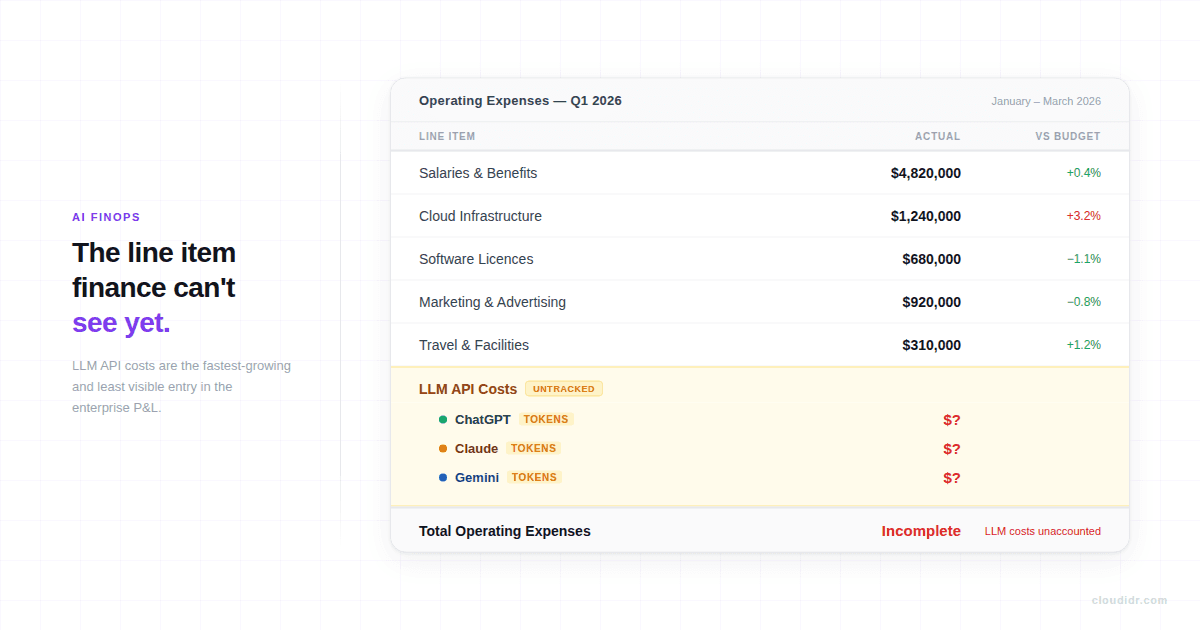
The CFO's Guide to LLM Cost Management: From Invisible Line Item to Real-Time Governed Investment
The CFO's Guide to LLM Cost Management: From Invisible Line Item to Real-Time Governed Investment
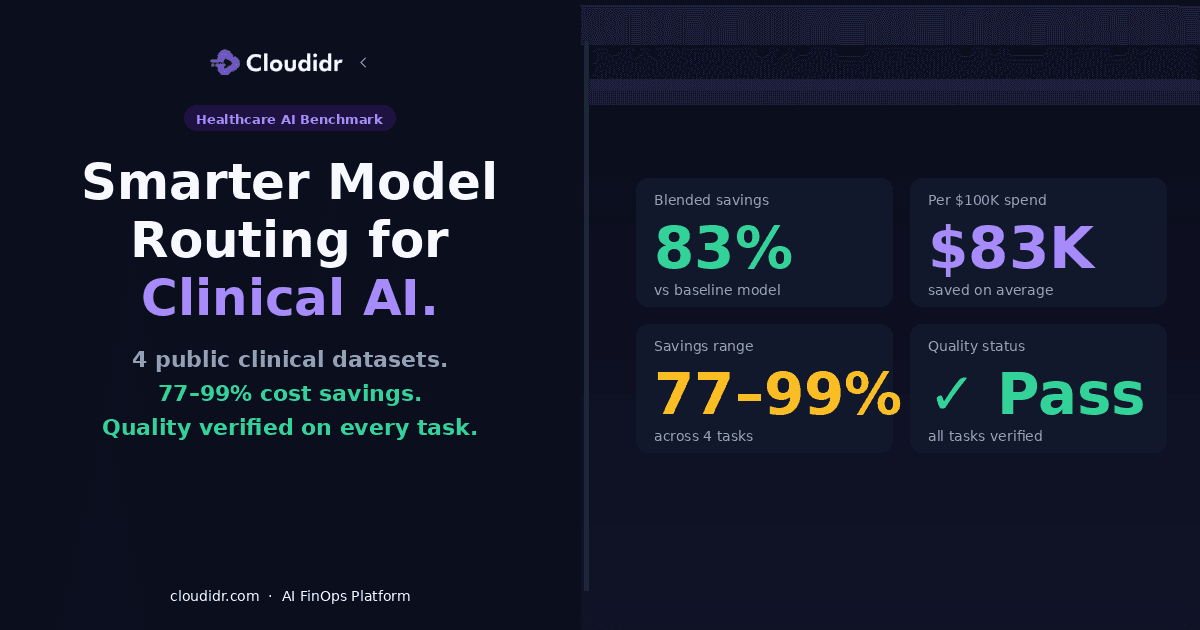
Smarter Model Routing for Clinical Summarization and ED Triage: What We Benchmarked and What We Saved
Smarter Model Routing for Clinical Summarization and ED Triage: What We Benchmarked and What We Saved
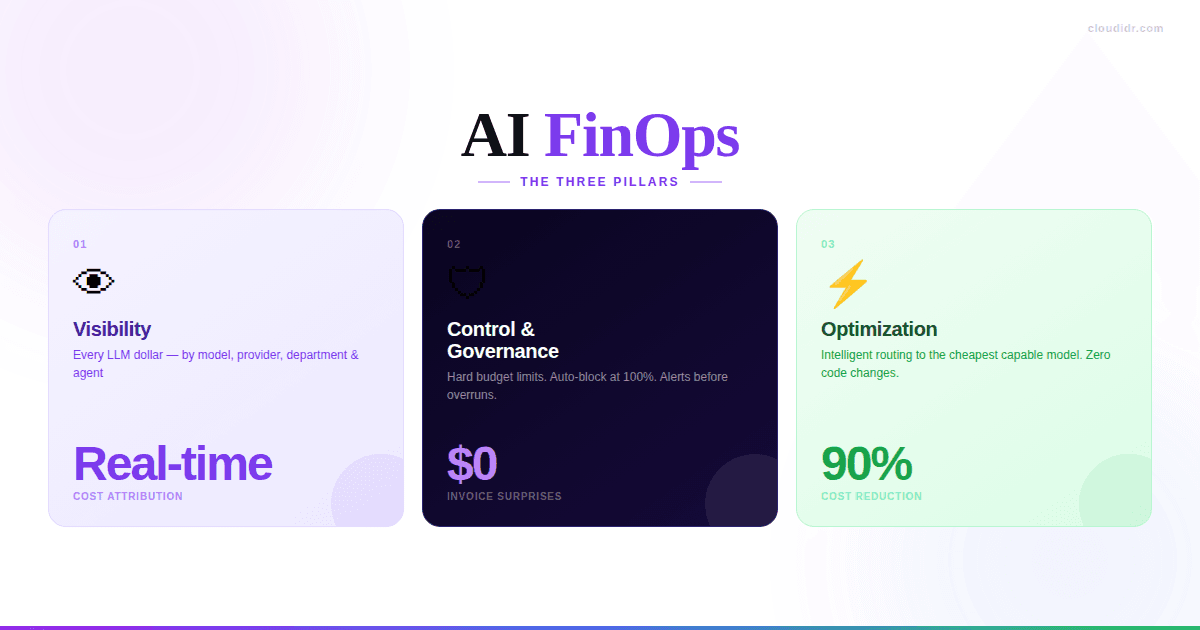
AI FinOps: The New Discipline Every AI-First Company Needs
AI FinOps: The New Discipline Every AI-First Company Needs
Load More
Load More


Backed by



Backed by
Backed by